GitHub - MagicStack/uvloop: Ultra fast asyncio event loop.
uvloop is a fast, drop-in replacement of the built-in asyncio event loop. uvloop is implemented in Cython and uses libuv under the hood.
The project documentation can be found
. Please also check out the
.
Performance
uvloop makes asyncio 2-4x faster.
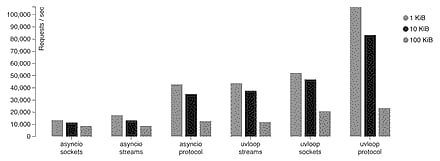
The above chart shows the performance of an echo server with different message sizes. The sockets benchmark uses loop.sock_recv() and loop.sock_sendall() methods; the streams benchmark uses asyncio high-level streams, created by the asyncio.start_server() function; and the protocol benchmark uses loop.create_server() with a simple echo protocol. Read more about uvloop in a
about it.
Installation
uvloop requires Python 3.8 or greater and is available on PyPI. Use pip to install it:
$ pip install uvloop Note that it is highly recommended to upgrade pip before installing uvloop with:
$ pip install -U pip Using uvloop
As of uvloop 0.18, the preferred way of using it is via the uvloop.run() helper function:
importuvloopasyncdefmain(): # Main entry-point. ... uvloop.run(main())uvloop.run() works by simply configuring asyncio.run() to use uvloop, passing all of the arguments to it, such as debug, e.g. uvloop.run(main(), debug=True).
With Python 3.11 and earlier the following alternative snippet can be used:
importasyncioimportsysimportuvloopasyncdefmain(): # Main entry-point. ... ifsys.version_info>= (3, 11): withasyncio.Runner(loop_factory=uvloop.new_event_loop) asrunner: runner.run(main()) else: uvloop.install() asyncio.run(main())Building From Source
To build uvloop, you'll need Python 3.8 or greater:
Clone the repository:
$ git clone --recursive [email protected]:MagicStack/uvloop.git $ cd uvloop
Create a virtual environment and activate it:
$ python3 -m venv uvloop-dev $ source uvloop-dev/bin/activate
Install development dependencies:
$ pip install -e .[dev]
Build and run tests:
$ make $ make test
License
uvloop is dual-licensed under MIT and Apache 2.0 licenses.